
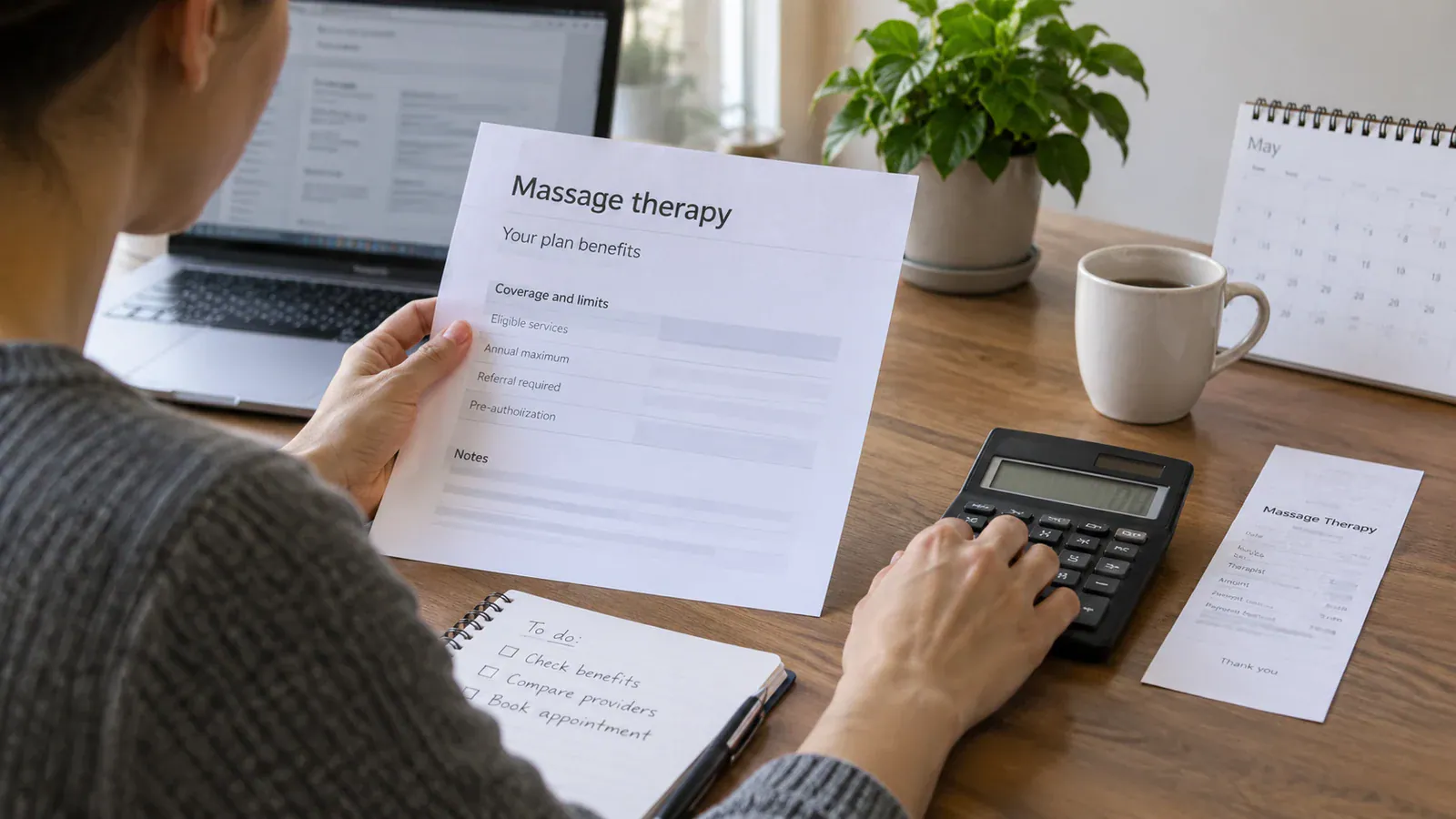
Massage therapy may be covered by a workplace or personal insurance plan, but coverage depends on your specific policy. All our practitioners are insurance eligible. Before booking, check your remaining benefits balance and claim rules for the appointment you want. A clinic’s ability to submit claims directly does not mean every plan will pay for every massage visit.
At our Winnipeg clinic, we can help you choose a massage appointment and explain the fee. We offer direct billing with all the insurers listed on our website. Your insurer confirms what your individual plan will pay.
At a glance
- All Alleviate practitioners are insurance eligible; your plan determines service benefits and reimbursement.
- Direct billing submits the claim for you; it does not guarantee full payment.
- Some benefits renew in January. Reset dates, carryover and claim deadlines vary by plan.
- Annual limits may be shared with other services; a spouse’s plan may help with eligible unpaid costs.
- Choose treatment around your needs, with a clear idea of your out-of-pocket cost.
As the end of the year approaches, checking your remaining benefits can help you plan care you’ve been putting off. If pain, muscle tension or a busy schedule has kept your own care on the back burner, this is a practical time to see what your plan covers.
Your quick coverage check
- Find your current massage benefits in your insurer account or benefits booklet.
- Check your service benefits and any referral requirement.
- Review the reimbursement percentage, eligible-fee limit, remaining balance and whether the annual allowance is shared.
- Check the benefit-year reset date and claim-submission deadline.
- Bring your insurance details and budget for any amount your plan does not cover.
Why check your massage benefits before the end of the year?
Some massage benefits run on a calendar year and renew in January; other plans use a different benefit-year cycle. Canada Life’s massage insurance guide gives examples of calendar-year limits. Check your own reset date rather than assuming every policy starts over at the same time.
If your annual massage allowance does not carry forward, its unused portion won’t be added to next year’s allowance. That can make this a useful time to arrange care you’ve been putting off. Choose the appointment because it fits your needs and your practitioner’s assessment, rather than booking extra treatment simply to use the balance.
A health spending account may work differently from your regular massage benefit. Manitoba Blue Cross explains that some HSA plans carry forward credits or eligible expenses, while others do not. Check the expiry and carryover rules for each part of your coverage separately; do not assume a spending account follows your massage allowance.
The appointment date and claim deadline are different
The deadline for submitting a receipt may fall after the benefit period in which you received treatment. That extra time is for claiming eligible past expenses; it does not automatically extend the treatment period. Your policy sets which benefit year a visit belongs to. Booking or prepaying before year-end does not by itself establish that a later appointment qualifies under this year’s benefits.
Before choosing a time, check your remaining balance, including any claims still being processed. Confirm the practitioner, appointment fee and expected out-of-pocket amount, then look for a visit that works with your schedule. Planning ahead gives you time to sort out a referral or coverage question without rushing into extra sessions just to use the balance.

Have aches, tension or stress been pushed to the bottom of your list?
Perhaps your neck and shoulders feel tight after hours at a desk, your back aches after long days on your feet, or your muscles feel sore after exercise or physical work. You might also be carrying tension through a stressful season and finding it hard to unwind. These are useful concerns to discuss with a massage therapist, along with how they affect your comfort and daily activities.
Massage may provide short-term relief for some types of pain, but results vary and the evidence is limited for several conditions, as the NCCIH evidence summary explains. Tell your practitioner about your symptoms, health history and goals so you can discuss whether massage is appropriate. New, severe or worsening symptoms need medical advice rather than waiting for a year-end massage.
If you have been postponing that conversation, checking your benefits is a practical place to start. Explore our massage therapy in Winnipeg page to learn about our approaches, meet our therapists and find the booking options. We can help with appointment questions while your insurer confirms coverage, so you can choose care with a clearer idea of both the visit and the cost.
Does having massage coverage mean every appointment is covered?
No. Plans may set limits by provider, visit, dollar amount or benefit period. Some reimburse a percentage of an eligible charge; others set a maximum per visit. Your plan may also require a particular practitioner credential or documentation. The precise answer comes from your own plan, not from a general clinic webpage.
Manitoba Blue Cross directs members to their coverage information for benefit details, and Canada Life explains where members can find their benefits booklet. If the wording is unclear, ask the insurer about massage therapy with the named practitioner and the appointment you plan to book. Keep a note of the answer.
Coverage can change when your plan renews, your employer changes or your policy is amended. Use the current benefits booklet or member account for your appointment date.
What is the difference between direct billing and reimbursement?
With direct billing, the clinic sends an eligible claim to the insurer at or after the appointment. You may still owe a balance if the plan pays only part of the charge, a limit has been reached or the claim is declined. With reimbursement, you pay the clinic and submit the receipt under your plan’s process. Either way, the insurer decides the claim under your policy.
We offer direct billing with all the insurers listed on our website. Bring your insurance details to your appointment. All our massage practitioners are insurance eligible. Reimbursement depends on your plan, and any amount your insurer does not cover remains payable. If a claim cannot be submitted directly, you may need to pay for the visit and submit your receipt.
How do I estimate what I may owe?
Start with the fee for your appointment, then look at the amount your insurer considers eligible, the percentage it reimburses and your remaining balance. An eligible-fee limit can mean that “80% covered” is less than 80% of the clinic’s full charge. Manitoba Blue Cross explains how reasonable and customary fee limits affect reimbursement.
For a hypothetical example, if a $100 visit has an $80 eligible-fee limit and the plan pays 80% of that amount, reimbursement would be $64 and your share would be $36. This assumes sufficient benefits remain and no other deductions or limits apply. Illustrative example only; your fee and coverage may differ.
Your remaining annual balance can further limit payment. A plan with $40 left cannot pay the full $64 in that example from the same allowance. Required documentation and service benefits also affect whether a claim can be paid.

Is my annual limit for massage alone or shared with other services?
Some plans give massage its own annual maximum. Others share an allowance across services such as massage, physiotherapy and chiropractic care. With a shared allowance, claims for another included service reduce the amount available for massage, even if you haven’t had a massage this year. This Canada Life plan booklet illustrates different allowance structures; your own booklet determines which applies to you.
Can I use both my benefits and my spouse’s plan?
If you have coverage through your own employer and as a dependent on your spouse’s plan, submit your claim to your own plan first. You can then submit the unpaid portion to your spouse’s insurer with the first insurer’s explanation of benefits, the statement showing how the claim was paid. This is called coordination of benefits.
The second plan applies its own coverage limits, so full reimbursement is not guaranteed. Manitoba Blue Cross’s coordination guide explains this process and the different order that can apply to children’s claims. Other coverage arrangements may have different rules.
Do I need a referral, prescription or particular provider credential?
Some plans require a referral or prescription, or cover only practitioners with specified professional credentials. Those requirements apply to the named therapist and service on your claim. All our practitioners, including students, are insurance eligible. Your plan still determines which services and charges it reimburses. We can confirm who will provide your treatment and the service details; your benefits booklet sets the eligibility requirements.
If a referral or prescription is required, ask who may issue it, when it must be dated and whether the insurer needs a copy before or after the visit. If your plan does not require one, there is no reason to seek a document solely because someone else’s policy did. For a complex claim, get the insurer’s answer in writing or record the date, representative and reference number.
What should I know before my first appointment?
Our massage treatments and therapist profiles help you compare approaches and appointment options. Review the appointment name, length, fee and practitioner when booking. For practical guidance on clothing, draping and comfort, read what to wear to a massage.
Profiles such as Kris Balzer’s and April Polischuk’s explain their backgrounds and approaches. The booking options show the appointments available with each practitioner. All our massage practitioners are eligible for insurance coverage; check your plan’s massage benefits and reimbursement limits.
Review the cancellation terms before booking. If you’re considering an additional service during your visit, clarify how it will be billed and whether your plan covers it.
What if a direct-billing claim is declined?
The insurer’s response should identify why a claim was declined, such as missing information, an exhausted balance or an ineligible service or provider. A claim that could not be sent directly is different from a final denial of coverage: depending on the plan, you may still be able to submit a receipt yourself.
Keep your receipt and the insurer’s response. We can help clarify the appointment and billing details; your insurer handles coverage decisions. Before your next visit, resolve the reason for the declined claim so you know what to budget. If the claim pays only part, the receipt and benefit statement help you keep track of the remaining cost.
What if my plan does not cover it?
You can pay for your massage appointment yourself if it fits your needs and budget. Our massage therapy page lists appointment options and fees. If you’re unsure which option to choose, our team can help you find a starting point.
For help with a specific appointment at our Winnipeg clinic, contact our team. Our clinic serves Garden City and North Winnipeg from 770 Leila Avenue, Winnipeg. Bring your policy questions to your insurer and your treatment questions to the practitioner so each answer comes from the right place; then choose the current appointment through online booking if it fits your needs.